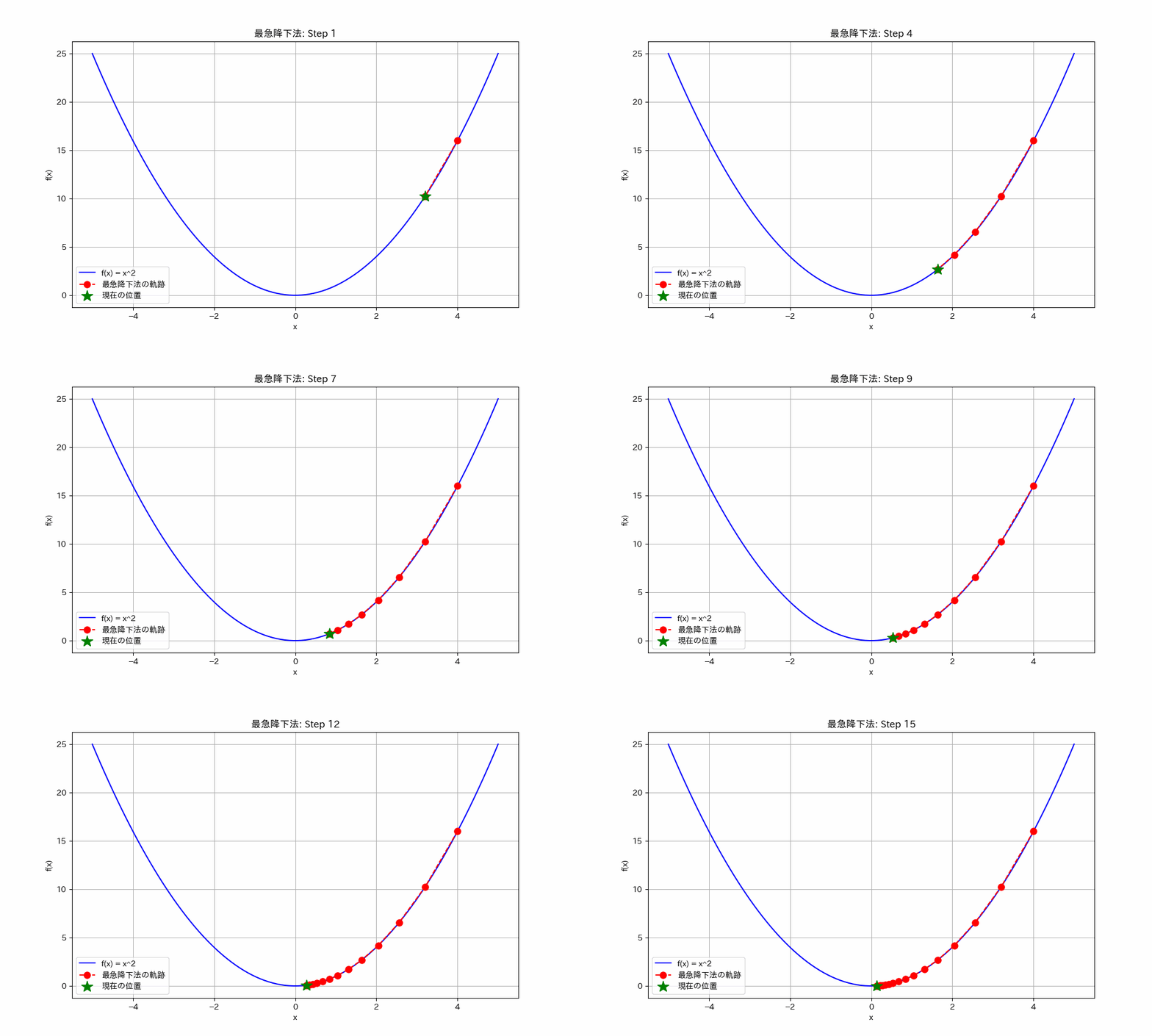
Gradient Descent
Let's minimize using gradient descent.
from typing import TypeVar
import numpy as np
from japanize_matplotlib import japanize
import matplotlib.pyplot as plt
from matplotlib.figure import Figure

japanize()

Number = TypeVar("Number", np.ndarray, float)


# Function to minimize: f(x) = x^2
def f(x: Number) -> Number:
    return x**2


# Gradient (derivative) of f(x): df/dx = 2x
def gradient(x: Number) -> Number:
    return 2 * x
Defining the Plot Function
def plot_steps(current_x: float, history_x: list[float], current_step: int) -> Figure:
    """
    Plot f(x) and the trajectory of gradient descent.

    Args:
        current_x: The current x position in gradient descent.
        history_x: A list of the x history so far.
        current_step: The current step number.

    Returns:
        Figure: The plot figure object.
    """

    # Create data for plotting f(x)
    x_curve = np.linspace(-5, 5, 100)
    y_curve = f(x_curve)

    # Create data for the computed points so far
    history_y = f(np.array(history_x))

    # Create the plot
    fig, ax = plt.subplots(figsize=(10, 6))
    ax.plot(x_curve, y_curve, "b-", label="f(x) = x^2")
    ax.plot(history_x, history_y, "ro--", label="Gradient descent trajectory", markersize=8)
    ax.plot(current_x, f(current_x), "g*", markersize=15, label="Current position")

    # Add labels and title
    ax.set_title(f"Gradient Descent: Step {current_step}")
    ax.set_xlabel("x")
    ax.set_ylabel("f(x)")
    ax.legend()
    ax.grid(True)

    return fig
Parameter Settings
- Learning rate:
learning_rate = 0.1 - Initial value:
initial_x = 4.0 - Number of steps:
total_steps = 3
The learning rate determines how large each update to x will be.
learning_rate = 0.1
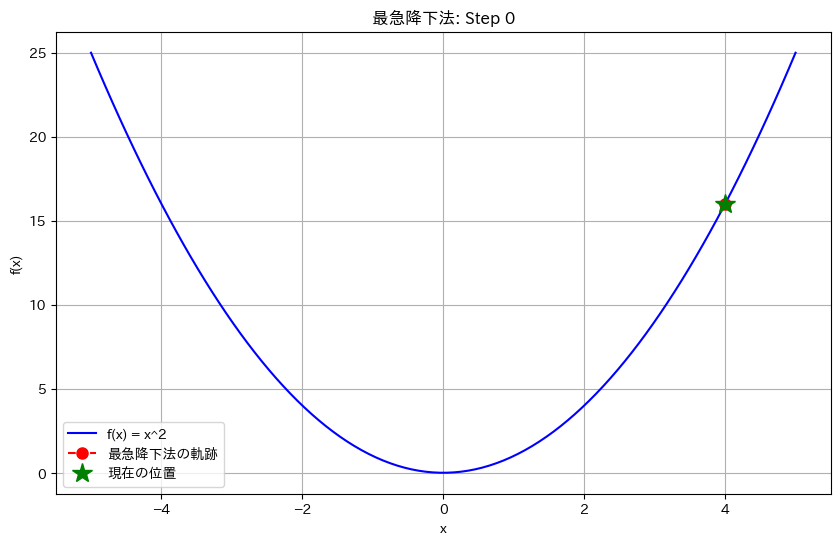
history_x = [current_x := 4.0]
total_steps = 3

plt.show(plot_steps(current_x, history_x, 0))
Running Gradient Descent
for i in range(total_steps):
    grad = gradient(current_x)

    # Gradient descent update step
    # x_new = x_old - learning_rate * grad
    prev_x = current_x
    current_x = current_x - learning_rate * grad

    history_x.append(current_x)

    step_num = i + 1
    print(f"\nStep {step_num}:")
    print(f"  Current position: x = {prev_x:.4f}")
    print(f"  Gradient ≈ {grad:.4f}")
    print(f"  New position: x = {current_x:.4f}")
    print(f"  Current function value: f(x) = {f(current_x):.4f}")

    fig = plot_steps(current_x, history_x, step_num)
    plt.show(fig)
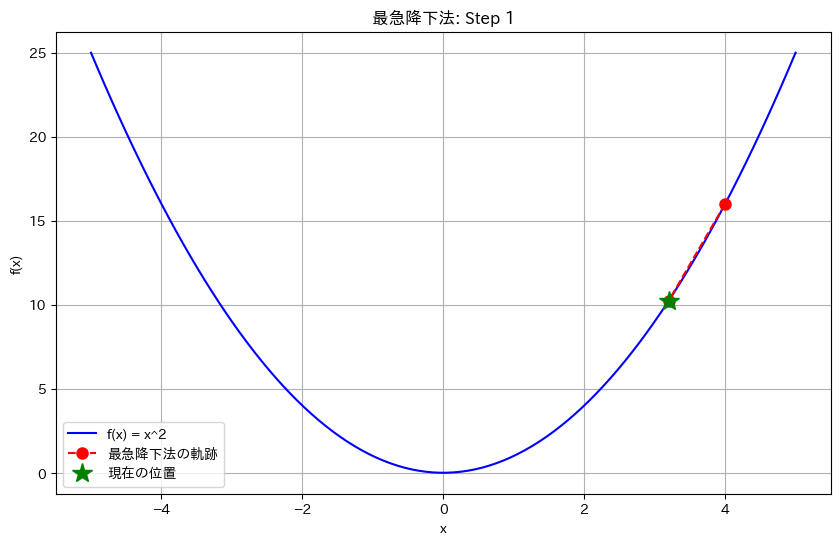
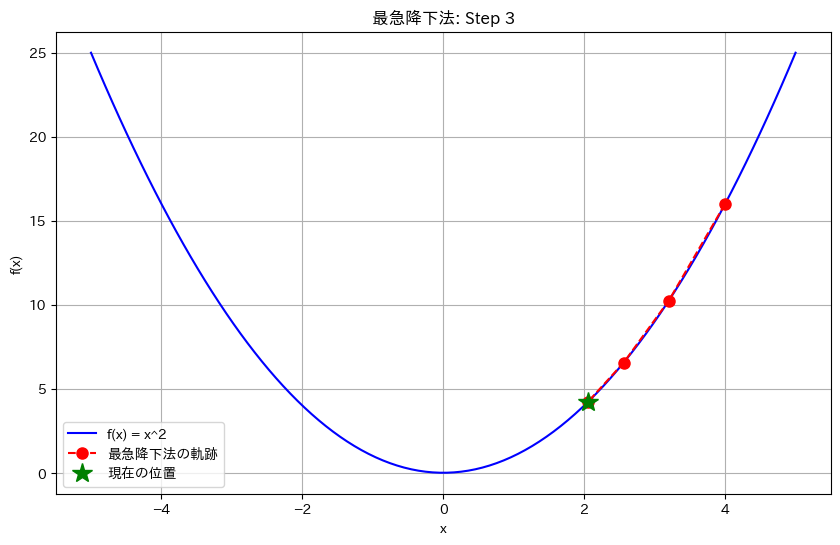
Step 1: Current position: x = 4.0000 Gradient ≈ 8.0000 New position: x = 3.2000 Current function value: f(x) = 10.2400
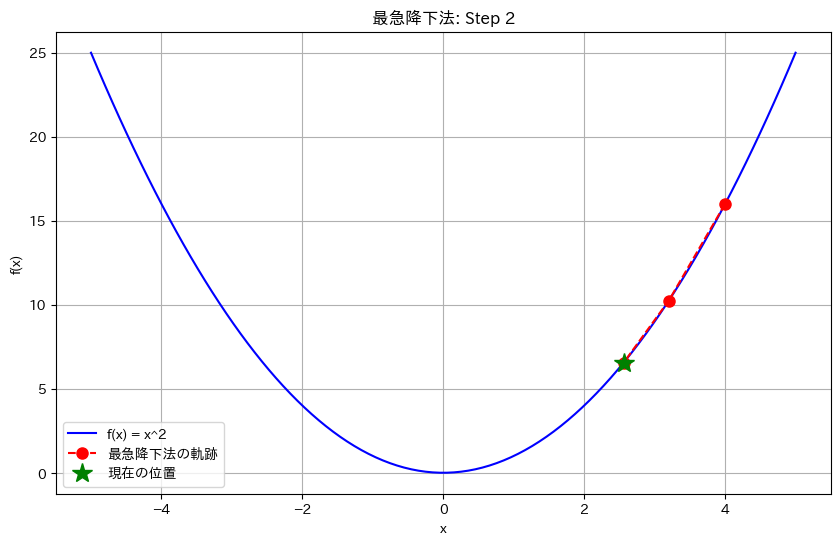
Step 2: Current position: x = 3.2000 Gradient ≈ 6.4000 New position: x = 2.5600 Current function value: f(x) = 6.5536
Step 3: Current position: x = 2.5600 Gradient ≈ 5.1200 New position: x = 2.0480 Current function value: f(x) = 4.1943
Bonus: Gradient Descent with More Steps
steps = 15
history_x = [current_x := 4.0]
history_figs = []

for i in range(steps):
    grad = gradient(current_x)
    current_x = current_x - learning_rate * grad
    history_x.append(current_x)
    history_figs.append(plot_steps(current_x, history_x, i + 1))

import imageio  # noqa

with imageio.get_writer(
    "gradient_descent.gif", mode="I", duration=0.5, loop=0
) as writer:
    for fig in history_figs:
        fig.savefig("temp.png")
        image = imageio.v2.imread("temp.png")
        writer.append_data(image)
        plt.close(fig)